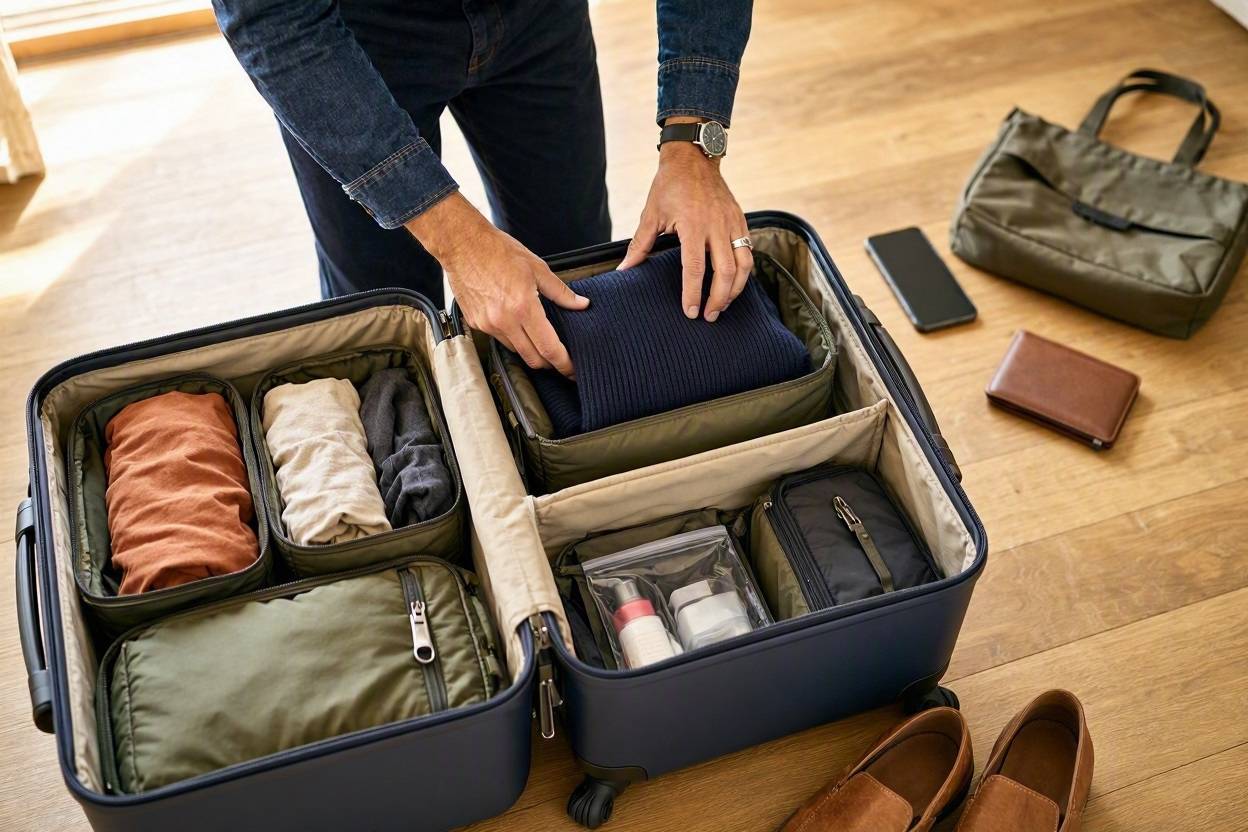
Packing for a trip sounds simple until you are standing in front of an open suitcase wondering whether you need three pairs of shoes, six shirts, two jackets, and an entire bathroom cabinet.
Then, somehow, the suitcase is still full.
The problem usually isn’t that you own too many things. It’s that most people pack by guessing rather than using a system.
Learning how to pack for a trip becomes much easier when you stop asking, “What might I need?” and start asking, “What will I actually use?”
A good packing system considers the length of your trip, the weather, your activities, laundry access, luggage restrictions, and the items that would be difficult or expensive to replace. Once you understand those factors, packing becomes faster, lighter, and much less stressful.
This guide walks you through a reusable system you can use for a weekend getaway, a week-long vacation, a business trip, or a much longer journey.
The goal isn’t to pack as little as possible.
The goal is to pack enough.
The Simple Rule for Packing Any Trip
Before putting anything into your suitcase, divide what you need into five categories:
- Documents and essentials
- Clothing
- Toiletries and personal care
- Technology
- Trip-specific items
This simple structure prevents two common problems.
First, you are less likely to forget something important.
Second, you are less likely to fill your suitcase with things that don’t have a clear purpose.
For every item you consider packing, ask:
What specific situation will I use this for?
If you can’t answer that question, the item probably doesn’t need to come with you.
There are exceptions, of course. Some emergency or backup items are worth carrying even if you hope never to use them. But most unnecessary packing comes from preparing for imaginary situations.
Start With Your Trip, Not Your Suitcase
One of the biggest packing mistakes is opening the suitcase before deciding what the trip actually requires.
Instead, start with the itinerary.
Write down:
- Destination
- Number of days
- Weather forecast
- Planned activities
- Dress requirements
- Accommodation
- Laundry availability
- Transportation
- Luggage allowance
For example, a five-day city trip involving walking, casual restaurants, and one nicer dinner requires a very different packing strategy from a five-day beach vacation.
The number of days alone does not tell you what to pack.
Your activities tell you much more.
Build a quick trip profile
Before packing, answer these questions:
| Question | Example |
|---|---|
| How long? | 6 days |
| Where? | New York City |
| Weather? | Cool and variable |
| Main activities? | Walking, sightseeing, restaurants |
| Dress code? | Mostly casual |
| Laundry? | No |
| Luggage? | Carry-on |
| Special items? | Comfortable walking shoes |
Now your packing decisions have context.
How Many Clothes Should You Pack?
There is no universal number of outfits that works for every trip.
A better approach is to pack outfits that can be mixed and matched.
For a typical one-week casual trip, you might start with:
| Item | Starting Point |
|---|---|
| T-shirts/tops | 5–7 |
| Pants/shorts/skirts | 2–3 |
| Underwear | 7–8 |
| Socks | 5–8 pairs |
| Sleepwear | 1–2 sets |
| Light layer | 1 |
| Jacket | Based on weather |
| Shoes | 2 pairs, sometimes 3 |
| Dressier outfit | 1 if needed |
These are starting points, not strict rules.
Someone traveling to a hot destination may need lightweight clothing but fewer layers. Someone visiting a cold destination may need fewer individual shirts but more substantial layers.
The key is to avoid packing one completely separate outfit for every day.
Think in combinations
Suppose you are traveling for seven days.
Instead of packing seven complete outfits, pack:
- Five tops
- Three bottoms
- One versatile layer
- One dressier option if necessary
- Enough underwear and socks
- Two pairs of shoes
Those pieces can create many different combinations.
This gives you variety without filling the suitcase.
The 3-Question Test for Every Clothing Item
Before packing a piece of clothing, ask three questions:
1. Does it fit the weather?
If the forecast doesn’t support it, don’t pack it unless it serves a realistic backup purpose.
2. Can I combine it with other items?
A shirt that only works with one specific pair of pants takes up valuable suitcase space.
3. Would I actually wear it?
This sounds obvious, but it eliminates a surprising amount of overpacking.
Many travelers pack clothes they might wear because they like the item.
Travel packing should focus on clothes you will actually wear on this particular trip.
Use the One-Week Clothing Rule
For many trips longer than a week, you do not need a separate outfit for every day.
Instead, pack approximately enough clothing for one week and plan to do laundry during longer trips.
For example, a two-week trip doesn’t necessarily require fourteen shirts and fourteen pairs of socks.
You could pack approximately a week’s worth of clothing, wash some items during the trip, and continue using them.
This becomes especially useful when traveling with only a carry-on.
Longer trips don’t always require bigger suitcases
The length of a trip matters, but it is not the only factor.
A 14-day trip with laundry access may require less luggage than a seven-day trip with formal events and multiple outfit changes.
Think about usage cycles, not just calendar days.
Pack for the Weather, Not the Season
One of the easiest ways to overpack is to look at the calendar instead of the actual weather.
A destination described as having a “summer” season may still have cool evenings.
A winter destination may have mild daytime temperatures.
Check the expected conditions before you pack.
Look at:
- Daytime temperatures
- Nighttime temperatures
- Rain
- Wind
- Humidity
- Snow
- Expected temperature changes
Then build your clothing around those conditions.
Layers are often better than bulky clothing
If temperatures can change throughout the day, layers are usually more versatile than packing several heavy pieces.
For example:
Base layer → shirt → sweater → jacket
You can remove or add layers depending on the temperature.
This gives you flexibility without requiring a completely different outfit for every weather condition.
Use a Clothing Color Strategy
You don’t need to create a perfectly coordinated travel wardrobe.
But choosing a simple color palette can make packing much easier.
For example, you might choose:
- Two neutral bottoms
- Several tops that work with both
- One accent color
- One versatile outer layer
The benefit is simple: almost everything works with almost everything else.
This reduces the temptation to pack additional clothes just because one item doesn’t match the rest.
Shoes Are the Biggest Packing Trap
Clothing is usually not what makes a suitcase feel impossibly heavy.
Shoes often are.
They take up a lot of space and can add substantial weight.
Before packing a pair of shoes, ask:
What does this pair do that another pair cannot?
For many trips, two pairs are enough:
- One comfortable everyday pair
- One additional pair for a specific purpose
A third pair may make sense for formal events, hiking, sports, or special activities.
But don’t pack multiple pairs that perform essentially the same job.
Wear your heaviest shoes during travel
If you need boots or heavier shoes, wearing them during transit can save valuable suitcase space and weight.
The same principle can apply to heavier jackets.
Wear the bulky items when practical rather than automatically packing them.
Don’t Pack “Just in Case” Clothing
“Just in case” is one of the most dangerous phrases in travel packing.
You may think:
“I’ll bring this in case I need something nicer.”
Then:
“I’ll bring another sweater in case it gets cold.”
Then:
“I’ll bring another pair of pants in case something gets dirty.”
Suddenly, your suitcase contains several backup outfits.
Instead, distinguish between reasonable backup items and imaginary scenarios.
A rain jacket when rain is possible is reasonable.
Three different jackets because the weather might somehow change dramatically every day is probably not.

Pack Based on Activities
Your itinerary should determine what specialty items you bring.
City sightseeing
Prioritize:
- Comfortable shoes
- Versatile clothing
- Weather protection
- Small day bag
- Portable charger if needed
Beach vacation
Prioritize:
- Swimwear
- Sun protection
- Lightweight clothing
- Sandals
- Beach-specific items you cannot easily obtain
Business trip
Prioritize:
- Work clothing
- Appropriate shoes
- Laptop and accessories
- Documents
- One backup professional outfit if necessary
Hiking or outdoor trip
Prioritize:
- Appropriate footwear
- Activity-specific clothing
- Weather protection
- Necessary equipment
- Hydration and safety essentials
The mistake is packing for every possible activity rather than the activities you have actually planned.
Use the “One Purpose, One Item” Principle
Whenever possible, choose items that perform multiple jobs.
For example:
- A lightweight jacket that works for rain and cool evenings
- Pants that work for both sightseeing and dinner
- Shoes that work for walking and casual restaurants
- A scarf that can provide warmth and work as an accessory
The more versatile an item is, the more valuable it becomes in a small suitcase.
This is one of the easiest ways to pack light without feeling unprepared.
Toiletries: Downsize Everything You Can
Toiletries are another common source of unnecessary weight.
Instead of packing full-size containers, consider travel-size amounts for products you actually need.
Review:
- Shampoo
- Conditioner
- Face wash
- Moisturizer
- Toothpaste
- Skincare products
- Hair products
- Shaving products
- Cosmetics
Before packing each item, ask:
Do I need this specific product, or can I use what the hotel or destination provides?
If a product is essential to you, bring it.
If it is something you rarely use at home, there is usually no reason to suddenly bring it on vacation.
Don’t forget liquid restrictions
If you’re flying, check the current baggage and security rules that apply to your departure airport and airline.
For travelers departing from U.S. airports, the Transportation Security Administration currently advises that liquids, gels, and aerosols in carry-on baggage follow its 3-1-1 rule, including containers of 3.4 ounces or less and one quart-size clear bag per passenger. Rules can change, so check the current official guidance before your trip.
This is another reason to organize toiletries before the last minute.
Keep Important Items Easy to Reach
Not everything should be buried at the bottom of your suitcase.
Items you may need during transit should be easy to access.
Depending on your trip, this might include:
- Passport
- Identification
- Boarding information
- Phone
- Wallet
- Medications
- Charging cable
- Headphones
- Water bottle
- Small personal items
The U.S. Department of State recommends organizing important travel documents, keeping copies separately, and carrying photos of important documents when traveling internationally.
For security screening, TSA also recommends packing items such as liquids and larger electronics where they can be accessed easily.
The exact organization will depend on your airport, airline, destination, and travel setup.
What Should Go in Your Carry-On?
Your carry-on should contain the things that would cause a serious problem if your checked luggage were delayed.
A practical carry-on may include:
- Passport or identification
- Travel documents
- Wallet
- Phone
- Essential medication
- Chargers
- Important electronics
- Valuable items
- One basic change of clothes
- Essential toiletries
- Anything you cannot easily replace
The exact contents depend on the trip.
If your checked bag disappears for a day, you should still have the essentials needed to continue your journey.
For international travel, official guidance also recommends checking destination-specific entry requirements, passport validity, visa requirements, and medication restrictions before departure.
Create a Personal “Never Check” List
Some items should stay with you rather than being placed in checked baggage.
Your personal list might include:
- Passport
- Money
- Essential medication
- Important documents
- Valuable electronics
- Irreplaceable items
- Critical travel information
The exact rules for specific items vary, so always check the airline and relevant security authority before flying.
For medication in particular, destination rules matter. The U.S. Department of State notes that some medications that are legal in the United States may be restricted in other countries.
Organize Your Suitcase by Category
You don’t need an expensive collection of packing accessories to organize luggage.
Simple categories work well.
For example:
Packing cube 1: Tops
Packing cube 2: Bottoms
Packing cube 3: Underwear and socks
Small pouch: Electronics
Toiletry bag: Personal care
Separate bag: Shoes
The advantage isn’t just organization.
It also makes unpacking easier when you arrive.
Instead of digging through the entire suitcase to find one shirt, you know where each category belongs.
Rolling vs. Folding Clothes
There is no single packing method that is always best.
Rolling can be useful for:
- T-shirts
- Casual pants
- Lightweight clothing
- Underwear
- Smaller items
Folding may work better for:
- Structured clothing
- Dress shirts
- Jackets
- Items that wrinkle easily
The real objective is not to follow a particular packing technique.
It’s to use the available space efficiently while keeping clothing reasonably organized.
Pack in Layers
A useful packing structure is to group similar items into layers.
For example:
Bottom: Shoes and heavier items
Middle: Pants and larger clothing
Upper layer: Shirts and lighter clothing
Top: Items you may need first
TSA’s travel checklist similarly recommends packing items in layers and keeping certain screening-sensitive items accessible.
If you use packing cubes, the cubes themselves can serve as your layers.
The 80% Suitcase Rule
Try not to fill your suitcase to maximum capacity before leaving.
Leave some room.
Why?
Because you may return with:
- Souvenirs
- Gifts
- New clothing
- Local products
- Items you purchased during the trip
A suitcase packed to the absolute limit also becomes much harder to close.
Leaving some empty space gives you flexibility.
If you consistently return with more than you left with, consider making “room for the return trip” part of your packing strategy.
Pack an Emergency Mini-Kit
A small emergency kit can be useful without becoming a giant collection of supplies.
Depending on your needs, it might include:
- Basic first-aid supplies
- Necessary personal medications
- Spare glasses or contacts if applicable
- A few essential personal-care items
- Small repair supplies
- Backup contact information
The key word is small.
You don’t need to recreate a pharmacy or hardware store inside your suitcase.
For international travel, check destination-specific requirements for medications and health-related items before leaving.
Don’t Pack Items You Can Easily Replace
One of the best ways to reduce luggage is to recognize what you can buy at your destination.
For example, depending on where you are traveling, you may be able to purchase:
- Basic toiletries
- Simple snacks
- Disposable items
- Common clothing basics
- Small personal-care products
This doesn’t mean you should rely on buying everything after arrival.
If an item is essential, expensive, difficult to find, or specific to your needs, bring it.
But you don’t need to pack your entire household simply because you might need something.
What to Pack for a Weekend Trip
A short trip should usually be your easiest packing challenge.
For a two- or three-day trip, a simple starting point might be:
- 2–3 tops
- 1–2 bottoms
- Underwear for each day plus one extra
- Socks as needed
- Sleepwear
- One versatile layer
- One or two pairs of shoes
- Toiletries
- Electronics
- Travel documents
Adjust this based on weather and activities.
A weekend trip is an excellent opportunity to practice traveling with a smaller bag.

What to Pack for a One-Week Trip
For approximately one week, think in terms of combinations rather than seven complete outfits.
A starting point might include:
- 5–7 tops
- 2–3 bottoms
- 7–8 pairs of underwear
- 5–8 pairs of socks
- 1–2 sleepwear options
- 1 jacket or outer layer based on weather
- 2 pairs of shoes
- Activity-specific clothing
- Toiletries
- Electronics
- Important documents
If you have laundry access, you may be able to reduce the clothing even further.
What to Pack for a Two-Week Trip
For a two-week trip, resist the instinct to simply double everything.
Instead:
- Pack roughly a week’s worth of versatile clothing.
- Plan when you can do laundry.
- Add only items required for specific activities.
- Check whether your destination has easy access to basic necessities.
- Leave room for purchases.
The longer the trip, the more valuable a repeatable clothing system becomes.
How to Pack for Different Weather
Hot weather
Focus on:
- Lightweight clothing
- Breathable fabrics
- Comfortable footwear
- Sun protection
- Swimwear if needed
- A light layer for air-conditioned spaces
Avoid packing excessive heavy clothing unless the destination requires it.
Cold weather
Focus on layers rather than numerous bulky outfits.
Consider:
- Base layers
- Sweaters
- Warm outerwear
- Appropriate footwear
- Gloves or other accessories when needed
Wear bulky outerwear during transportation when practical.
Rainy weather
Bring appropriate protection rather than multiple backup outfits.
Consider:
- Waterproof or water-resistant outerwear
- Suitable shoes
- A compact rain layer
- A way to protect electronics
Variable weather
This is where a layering strategy becomes especially useful.
Instead of packing separate outfits for every possible temperature, build combinations that can adapt throughout the day.
How to Pack for Business Travel
Business travel requires a slightly different approach because clothing may need to meet specific expectations.
Before packing, determine exactly how many professional events you have.
Then build outfits around a small number of versatile pieces.
For example:
- Two pairs of professional pants
- Several shirts
- One jacket
- One pair of professional shoes
- One additional outfit if necessary
Choose colors and pieces that work together.
Don’t bring five different combinations if three pieces can create five useful outfits.
Also keep work essentials organized:
- Laptop
- Charger
- Documents
- Presentation materials
- Business cards if needed
- Appropriate accessories
How to Pack for a Family Trip
Family packing can become chaotic because everyone starts preparing independently.
A better system is to give each person responsibility for a category or personal bag.
For children, consider preparing separate small bags for:
- Clothing
- Toiletries
- Entertainment
- Travel essentials
Keep shared items together instead of packing duplicates.
For example, you may not need one large bottle of the same product in every person’s bag.
Create a family master list and check it before leaving.
This reduces both forgotten items and unnecessary duplicates.
The Night-Before Packing System
Do not leave your entire packing process until the final hour.
Instead, use three stages.
Two or three days before
Prepare:
- Travel documents
- Laundry
- Toiletries
- Chargers
- Activity-specific items
- Weather-appropriate clothing
The day before
Pack:
- Most clothing
- Shoes
- Toiletries
- Electronics you don’t need overnight
- Accessories
Before leaving
Check:
- Passport or ID
- Wallet
- Phone
- Medications
- Chargers
- Tickets or travel information
- Home essentials
- Luggage
This system reduces the chance that panic will cause you to throw unnecessary items into your suitcase.
The Final Packing Audit
Once your suitcase is packed, don’t immediately close it.
Take five minutes for a final audit.
Look at every category and ask:
What can I remove?
Start with:
- Duplicate items
- Clothes without a specific purpose
- Shoes that overlap with another pair
- “Maybe” outfits
- Toiletries available at your destination
- Items you packed because you felt you “should”
- Anything you can easily replace
Try removing a few items before adding anything else.
This final step is often where overpacking disappears.
A Complete Travel Packing Checklist
Use this as your reusable master checklist and customize it for each trip.
Documents and money
- Passport or identification
- Visa or required entry documents
- Boarding information
- Wallet and payment cards
- Emergency contact information
- Copies or secure digital backups of important documents
Clothing
- Tops
- Bottoms
- Underwear
- Socks
- Sleepwear
- Jacket or outer layer
- Activity-specific clothing
- Dressier outfit if required
- Swimwear if needed
Shoes
- Everyday walking shoes
- Second pair if needed
- Activity-specific footwear if required
Toiletries
- Toothbrush
- Toothpaste
- Skincare
- Hair-care products
- Personal-care items
- Shaving supplies if needed
- Cosmetics if needed
Technology
- Phone
- Phone charger
- Laptop or tablet if needed
- Charging cables
- Power bank if appropriate
- Headphones
- Plug adapter if required
Health and personal needs
- Essential medications
- Prescriptions or medication documentation
- Glasses or contact lenses
- Basic first-aid supplies
- Personal medical items
Trip-specific items
- Travel guide or itinerary
- Camera
- Beach items
- Hiking equipment
- Business materials
- Entertainment
- Other activity-specific equipment
A 10-Minute Anti-Overpacking Test
If you are still unsure whether your suitcase contains too much, use this quick test.
Step 1: Remove duplicates
If two items serve the same purpose, choose the better one.
Step 2: Remove imaginary outfits
Take out clothing you packed only because you might wear it.
Step 3: Remove unnecessary shoes
Keep the pairs that perform different functions.
Step 4: Check the weather again
If the forecast changed, adjust your clothing.
Step 5: Check your itinerary
If you are no longer doing an activity, remove the equipment associated with it.
Step 6: Check the luggage limit
Make sure the bag meets your airline’s current size and weight requirements.
Step 7: Leave some space
Your suitcase does not need to be completely full.
This process is usually more effective than trying to become a minimalist overnight.

The Best Packing System Is the One You Can Repeat
You do not need to reinvent your packing process for every vacation.
Create a personal system that works for you.
For example:
Trip details → Weather → Activities → Clothing combinations → Toiletries → Technology → Documents → Final audit
After several trips, you will notice that many of your packing decisions repeat.
You can eventually create a permanent master packing list on your phone and duplicate it whenever you plan a new trip.
Then you only need to add the destination-specific items.
This turns packing from a stressful task into a short routine.
Frequently Asked Questions About How to Pack for a Trip
How do I pack for a trip without overpacking?
Start with your itinerary, weather, activities, and luggage allowance. Pack versatile clothing that can be mixed and matched, limit shoes, use travel-size toiletries when appropriate, and remove items that do not have a clear purpose.
How many outfits should I pack for a trip?
For a typical one-week trip, many travelers can start with five to seven tops and two to three bottoms, then adjust based on weather, activities, dress requirements, and laundry access. You usually do not need one completely separate outfit for every day.
Is it better to roll or fold clothes when packing?
Both methods can work. Rolling is useful for many casual and lightweight items, while folding may be better for structured or wrinkle-prone clothing. The best method is the one that keeps your suitcase organized and makes good use of the available space.
How many pairs of shoes should I pack for vacation?
For many trips, two pairs are enough: one comfortable everyday pair and one additional pair for a different purpose. Special activities or formal events may justify another pair.
How can I pack light for a long trip?
Pack for approximately one week of clothing, choose versatile pieces, plan to do laundry, and avoid packing duplicate items. A longer trip does not necessarily require a larger wardrobe.
What should I put in my carry-on?
Keep important documents, valuables, essential medication, electronics, chargers, and other items you would need if your checked bag were delayed. You can also include a basic change of clothes and essential toiletries.
What should I pack for a 3-day trip?
Start with two or three tops, one or two bottoms, underwear and socks, sleepwear, one versatile layer, appropriate shoes, toiletries, electronics, and travel documents. Adjust the list for the weather and activities.
How can I stop packing too many clothes?
Create outfits before packing and make sure each clothing item works with several others. Remove anything that is only a “just in case” option and avoid packing a separate outfit for every possible situation.
Should I pack for every possible weather condition?
No. Check the expected weather and prepare for realistic variations. Layers are often more useful than packing several completely different outfits.
What is the most important thing to remember when packing?
Pack for the trip you are actually taking, not every trip you can imagine taking. Your itinerary, weather, activities, and personal needs should determine what goes into the suitcase.
Make Packing Part of Your Travel Routine
Packing becomes much easier when you stop treating it as a last-minute guessing game.
Start with the trip.
Check the weather.
Review your activities.
Build a small collection of versatile outfits.
Limit duplicate items.
Keep important things accessible.
Then perform one final audit before you leave.
You do not need the perfect suitcase.
You need a suitcase that contains what you will actually use.
The next time you ask yourself how to pack for a trip, don’t start by throwing clothes into a bag. Start with a plan.
That small change can save space, reduce stress, make transportation easier, and help you enjoy the trip from the moment you leave home.
At DailySimpler, we believe everyday tasks should be easier, not more complicated. Save this packing system and use it the next time you’re getting ready to travel.


